




Project overview
Blox at a glance
Blox is an original puzzle game developed as part of Plurok’s product development journey. It pairs accessible gameplay with mechanics that grow more demanding over time, asking players to think ahead, spot patterns, and adapt as they progress.
- Project
- Blox
- Developer
- Plurok
- Category
- Puzzle / Strategy
- Platforms
- Web and mobile
- Main experience
- Circuit
- Development focus
- Gameplay, progression, usability, and replayability


The idea
We wanted players to understand the game almost immediately. The tutorial should not outlast the first level, and the game should not overwhelm new players with complicated menus or dozens of systems before they begin. The rules needed to feel approachable while leaving room for players to improve.
That balance became one of the most interesting design problems. Even a simple mechanic can become complex once combinations, progression, obstacles, and harder levels enter the picture.
Every new feature needed a clear purpose and had to improve the experience. We started looking at how the systems worked together instead of treating each feature as a goal on its own.
Understanding the gameplay
Blox is built around puzzle-solving and strategic decisions. Players work through challenges by reading the board, spotting opportunities, and planning their next moves.
As the game progresses, new mechanics add layers of complexity. They ask players to approach familiar situations in new ways. Some challenges reward careful planning; others introduce unexpected obstacles that make players reconsider their strategy.
The result is a progression that helps players learn the game while continuing to present new situations.
1Pick a piece
- ↓
2Place it on the board
- +10
3Full rows disappear
From the game
Screenshots from the current prototype.
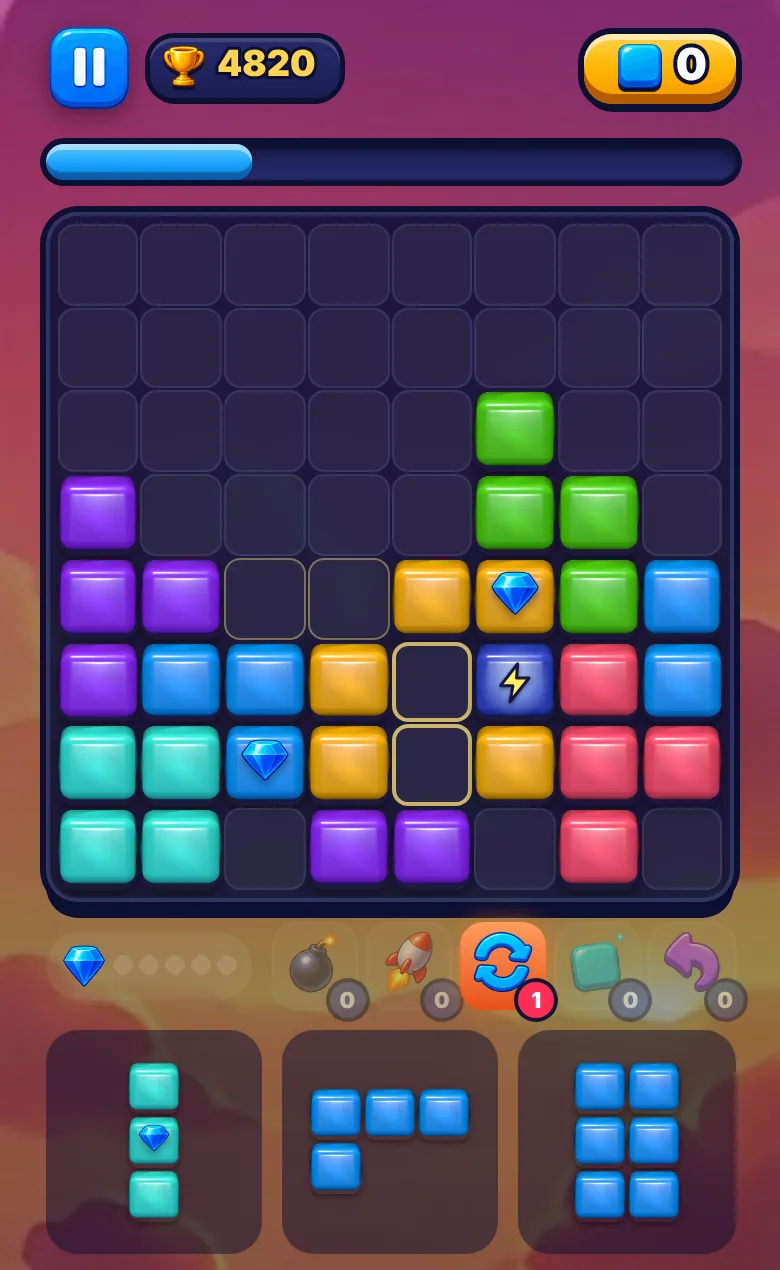
A game in progress, with gems on two Blox and a Lightning Rare Blox. 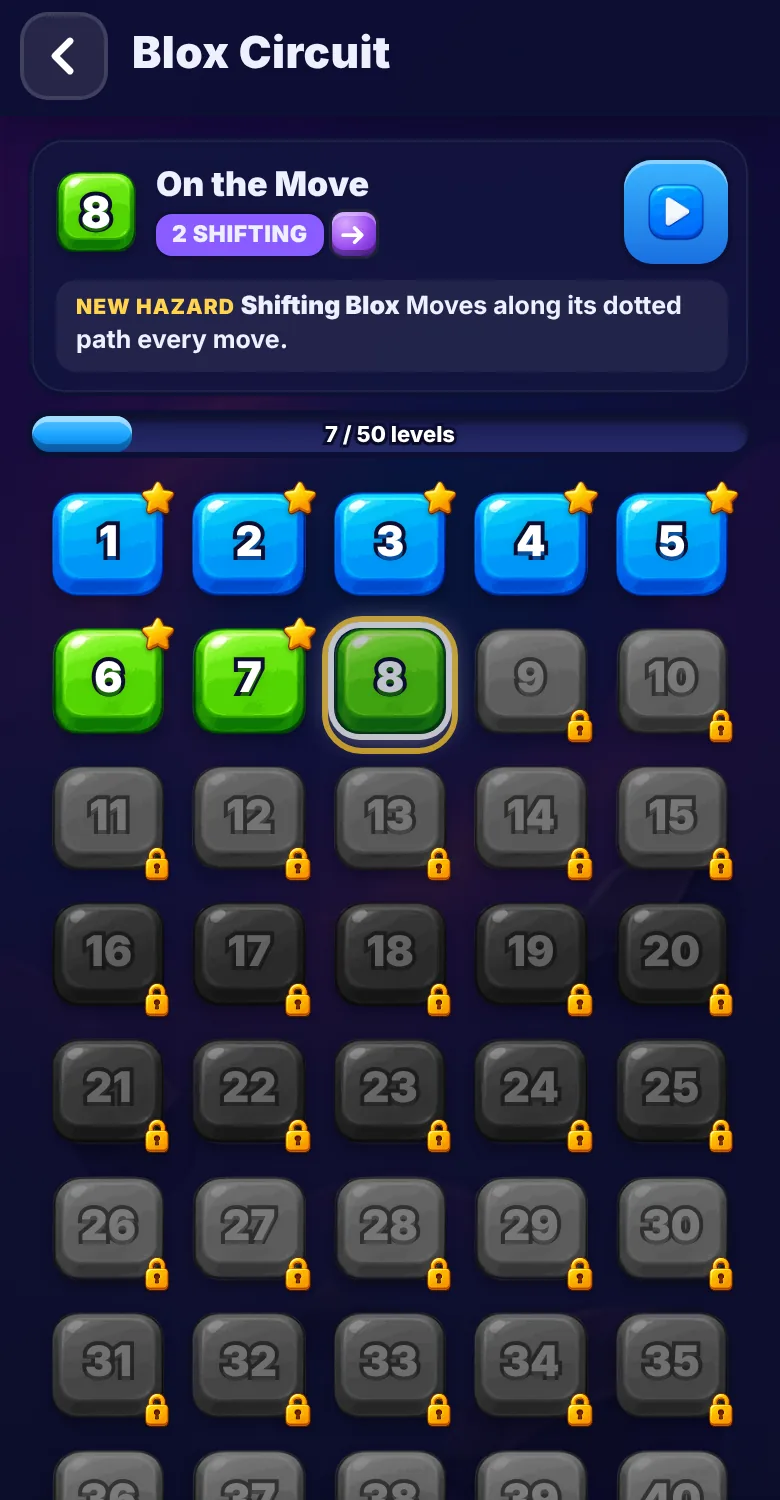
The Circuit map. Levels open one at a time. 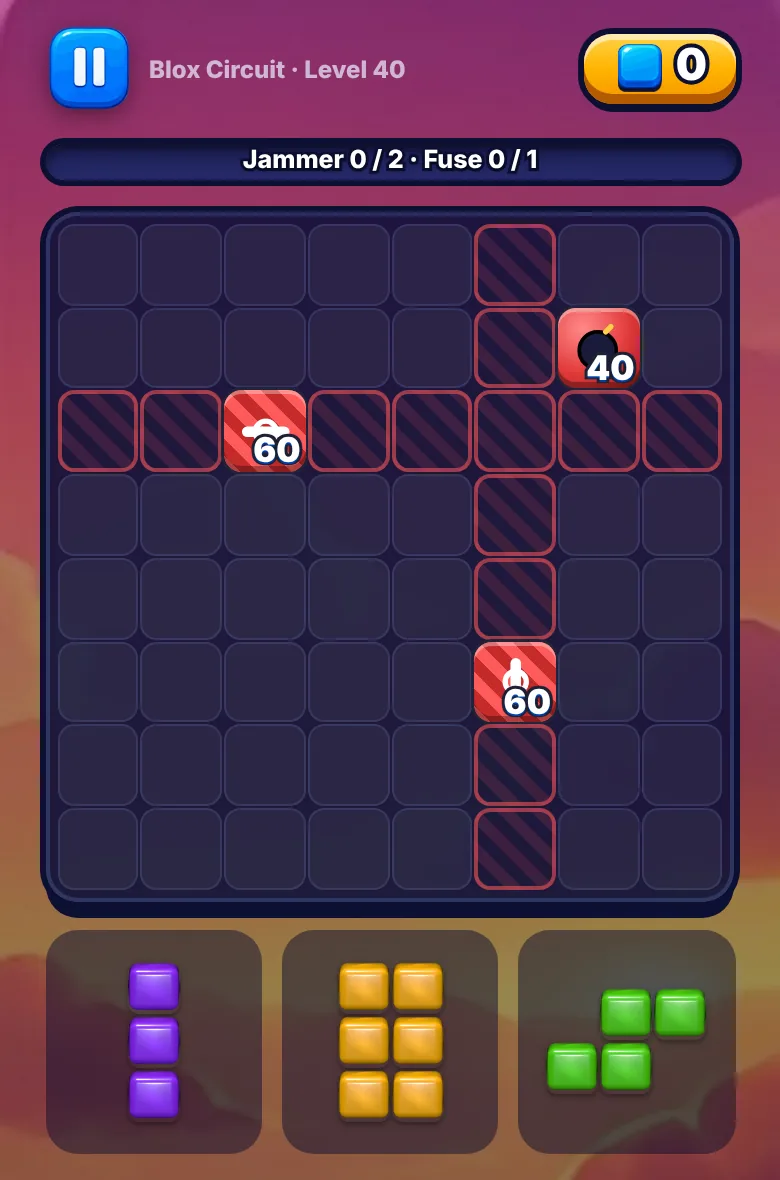
Level 40, Crossfire: two Jammer Blox and a Fuse Blox. 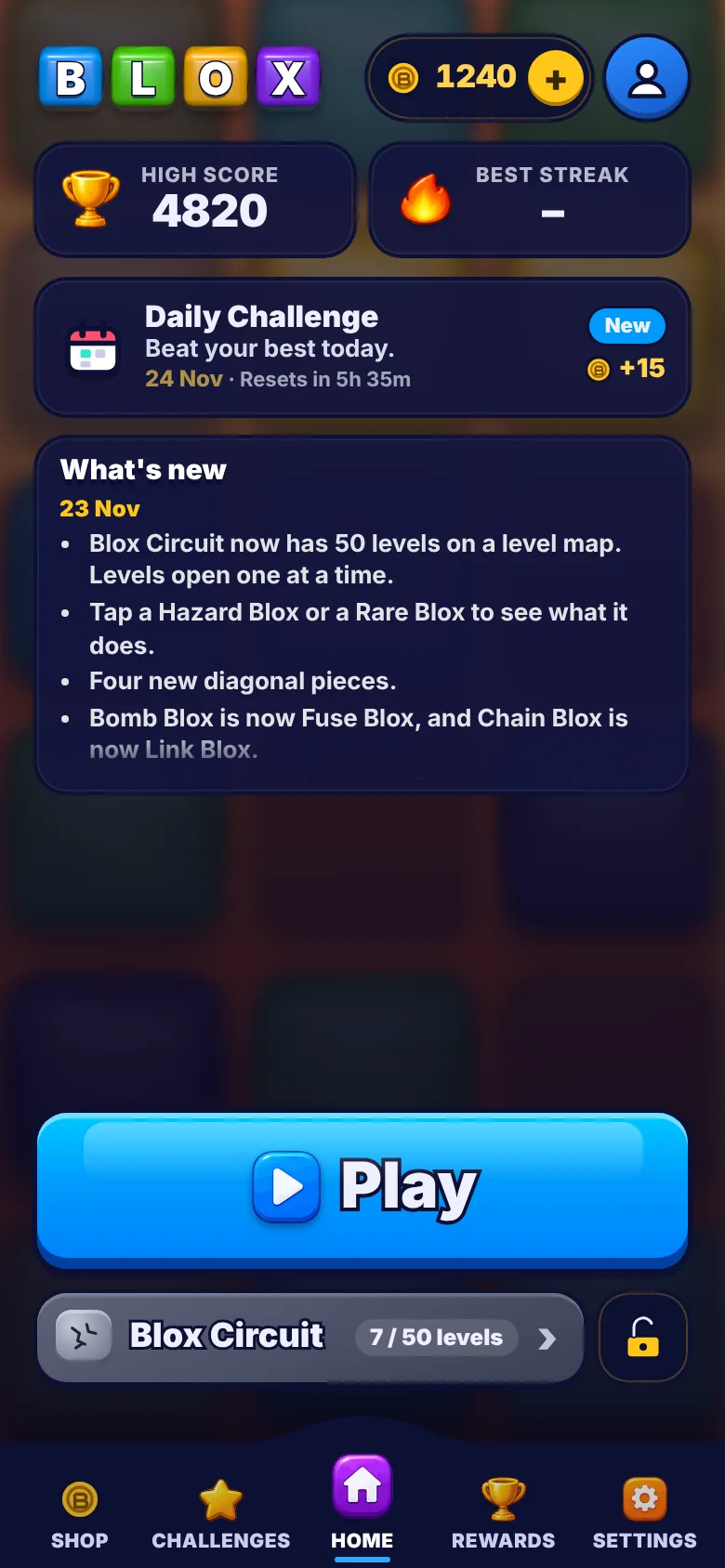
The home screen: Play, the Daily Challenge and Blox Circuit.
Circuit: The main challenge
Circuit is one of Blox’s central experiences. It brings together a structured sequence of levels that introduces mechanics, builds player understanding, and gradually increases the difficulty.
The current development scope includes 50 levels. New challenges appear as players advance, giving them room to learn through play. Each completed level should feel like progress, not just another item checked off a list.
Introducing hazards
The current design identifies 10 hazard types:
 StoneCounts for full lines. Never breaks.
 FrozenCracks on the first clear. Breaks on the second.
 RustGrows every 2 moves. Clear it before it turns to Stone.
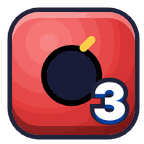 FuseCounts down every move. Clear its line before it hits 0.
 SporeSpreads to an empty neighbour every 2 moves.
 ShiftingMoves along its dotted path every move.
 JammerIts line cannot clear. Clear the crossing line to free it.
 SealedBreaks only when its row and column clear together.
 LinkLinked Blox break only together, in one move.
 MimicOpen it breaks, shielded it stays. Switches every move.
Each one introduces a different gameplay consideration and changes how players approach familiar situations. Hazards help keep the experience varied and open up new possibilities for level design. The aim is to make every mechanic clear while still giving players something to think through.
Rare Blox
Hazards make the board harder. Rare Blox work the other way: a Piece can carry one, and its effect triggers when the Blox is cleared. There are seven, in three rarity tiers.

RainbowRare
Clears every Blox in the most common colour.

GoldRare
Double points for the move.

JellyRare
Stays on the Board after it is cleared and can trigger once more.

LightningEpic
Clears its whole row and column.

LavaEpic
Melts the 3 × 3 area around it.

GalaxyLegendary
A black hole clears every Blox within 2 Cells.

CrystalLegendary
Gives a random free Power-up.

Behind the build
Building Blox meant more than implementing the rules of the game. The work covered several connected parts of the product:
- 01
Gameplay systems
The first priority was a solid foundation. Core mechanics had to behave consistently before we could add more systems.
The logic, interactions, and rules needed to be predictable. When something happens on screen, players should understand why.
- 02
Level design
Making one enjoyable level is one thing. Making 50 levels feel like a coherent progression is another.
Levels need variation and pacing, with complexity introduced gradually. A new mechanic should feel like an interesting discovery rather than an arbitrary obstacle.
- 03
Interface and usability
The interface needed to make the game easy to approach without distracting from play. Menus, navigation, visual feedback, and interaction patterns all shape how a game feels.
We paid close attention to clarity and wanted to validate those choices through external testing instead of relying on our own assumptions.
- 04
Polish and iteration
A feature can work correctly and still feel wrong. Animations, feedback, timing, transitions, and small interaction details all affect the experience.
Iteration helped us improve those details. Sometimes the best change was to remove complexity or make an existing interaction clearer.


The technology behind Blox
Blox is a software product as well as a game. Its development spans gameplay logic, interface work, and making sure the experience works across different screen sizes.
Software development
Building and maintaining the systems that make the game work.
Interface and experience design
Creating a consistent visual language and helping players move through the game naturally.
AI-assisted development
Using AI tools to speed up research, problem-solving, and implementation. AI can help with the work, but people still decide what to build, evaluate the result, and take responsibility for its quality.
Testing and iteration
Checking that features work, finding problems, and improving the experience through repeated testing.
The tools support a workflow that brings these parts together and produces something people can use.
The people and process behind the project
Blox is being developed within Plurok’s own product environment. Building an original product gives us a chance to work through the same decisions our future clients will face. What should come first? What deserves more time? How can we tell whether something works? When should we stop adding features and improve what is already there?
Those questions rarely have automatic answers. Product development involves experiments, compromises, and occasional changes of direction.
Ideas are easy to get excited about. Turning them into something functional takes patience and consistency, along with a willingness to revisit decisions that seemed perfectly reasonable a week earlier.
Good products rarely come from one uninterrupted burst of inspiration. They take shape through a series of small decisions.
Testing: Taking it outside the development environment
One of the most important milestones was putting Blox in front of external testers. After spending time with a product, developers learn its logic, its menus, and what each mechanic is meant to do. Players arrive without that context, which makes their feedback useful.
The feedback collected so far has been encouraging. Testers described the game as understandable and fun, and found the menus easy to navigate.
Most testers had not completed the full Circuit experience. That was not necessarily because they disliked it: playing through many levels takes time, and people have work and other commitments. It reminded us to respect players’ time while offering enough content and progression to keep the game interesting.
Early positive feedback gives us a starting point for further testing and improvements.
Blox by the numbers
A snapshot of the project’s current scope.
- 50
- Playable levels in the Circuit development scope
- 10
- Identified hazard types
- 1
- Original game in the Plurok product portfolio
- 2
- Target platforms: web and mobile
- ∞
- Small decisions, adjustments, and iterations behind the experience
These figures describe the project’s scope. They do not represent commercial performance or player adoption.
What we learned
Blox has reinforced that product quality depends on both working technology and understanding the people who use it. A technically correct feature can still be confusing. A clever mechanic can still frustrate players, and a beautiful interface can make simple tasks harder than they need to be.
- 01Does it work?
- 02Does it make sense?
- 03Is it enjoyable to use?
- 04Does it fit into the wider experience?
- 05Is it worth maintaining and developing further?
We now measure progress by more than new features. Simplifying, refining, or reconsidering existing work can move a product forward.
That way of thinking applies to games, software, websites, and almost any other digital product.

What comes next?
Blox is still evolving. There is room to improve the existing experience, refine the gameplay, develop the visual presentation, and keep learning how players interact with the game.
The focus is on making the product feel complete and cohesive rather than chasing an endless list of features. Testing, practical experience, and the direction of the project will continue to shape what comes next.
We are interested in what Blox can become, and in understanding what makes it worth playing.
More than a game
Blox is an important part of Plurok’s development. It gives us the chance to build something ourselves, make decisions from the ground up, and experience the full process of turning an idea into a digital product.
What we learn from Blox reaches beyond games. The same principles apply to building a website, designing an application, developing an automated workflow, or solving a technical problem for a client.
Understand the problem. Build a solution. Test it. Improve it. Repeat.
Blox is one of our first steps. It will not be our last.
A Plurok project, built with curiosity and developed through iteration.